For hotels
Where should hotels place a room QR code so guests actually use it?
A QR code cannot help if guests never notice it. The best placement is convenient, easy to scan and connected to a service request the hotel can actually fulfil.
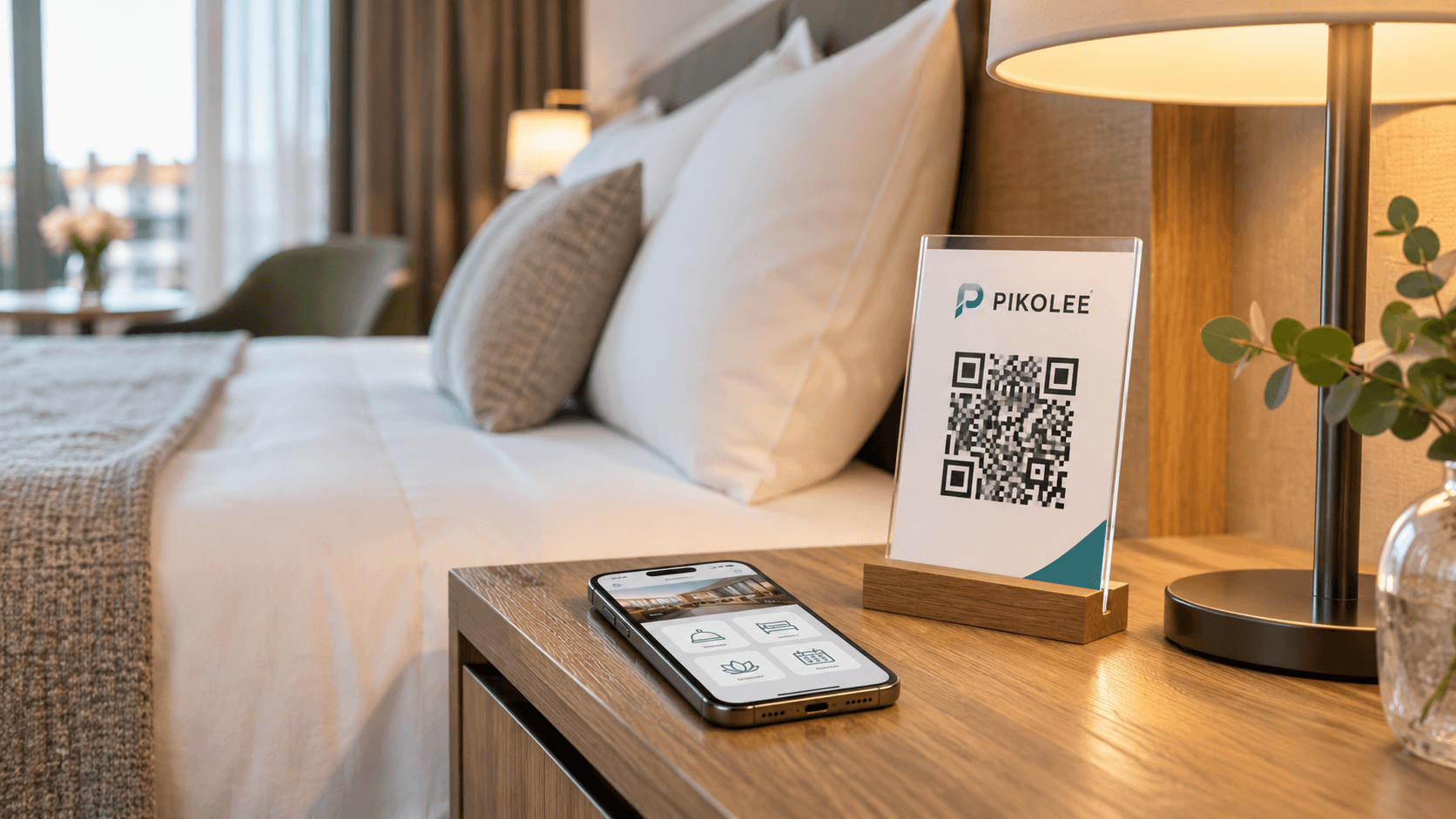
A hotel can have a beautifully designed digital service catalogue, but it means little if guests cannot find the QR code or do not understand why they should scan it. A tiny card hidden behind the kettle is an invisible service.
The useful question is not simply “Where should we put a code?” It is “When does a guest need towels, room cleaning, toiletries or help with a fault – and where is their phone at that moment?”
Start with the job the QR code needs to do
A public hotel information guide and a room-specific request channel are not the same thing. For common requests, one clear guest portal is generally easier to understand than several unrelated codes.
Guests may request towels, housekeeping, amenities or help with a problem. Display extras such as room-service meals, spa access and late check-out only if the property offers them and has a process for responding.
Five places to compare
There is no universally best spot. Test visibility and comfortable scanning inside the actual room before ordering signs.
| Location | Why it can work | Potential issue |
|---|---|---|
| Desk | Natural place for guest information | A laptop or luggage may hide the card |
| Bedside table | Convenient in the morning and evening | Limited space and lamp reflections |
| Near the TV | A useful reminder of available services | Too far away to scan comfortably |
| Entrance area | Visible on arrival | Guests may not need a service at that moment |
| Bathroom | Towels and toiletries are used there | Moisture, cleaning and little free space |
Desk versus bedside table: the two strongest starting points
A small stable sign on the desk is easy to discover alongside other hotel information. Keep it clear of leaflets and appliances. Rather than adding more clutter, consider removing an outdated printed brochure.
A bedside sign meets guests when they are resting or preparing for the day. Make sure it does not crowd a lamp, phone charger or personal belongings. Small rooms may need just one well-chosen spot.
A TV screen is better as an additional reminder than the only access point. A bathroom code needs a specific purpose and material that stands up to cleaning.
Printing: test one card before ordering fifty
For a tabletop sign, a QR code about 4–5 cm wide is a reasonable first prototype, not a technical standard. Readability depends on encoded data, module size, contrast, printer quality and scanning distance.
Keep a dark code on a light background with no decoration touching the symbol. DENSO WAVE specifies a clear quiet zone of four modules on each side of a standard QR Code.
Try a sample in a dimly lit room with both an iPhone and an Android device. Matte surfaces often avoid glare better than glossy lamination.
Choose signs that housekeeping can maintain
Stable acrylic stands, laminated cards and durable labels can all work. Pick materials that are easy to wipe clean, difficult to displace accidentally and straightforward to replace.
Add a quick visual check to the room-cleaning routine: the sign is in the right place, readable, clean and undamaged. A room number on the back helps prevent moving a room-specific sign to the wrong room.
What should the sign actually say?
A bare QR code could mean Wi-Fi, a survey, a restaurant menu or something suspicious. State the benefit and explain that guests can use their normal phone camera.
Suggested sign: “Need something for your room? Towels · Housekeeping · Amenities · Hotel services. Scan with your phone camera. No app to install.”
If a hotel offers paid services, display accurate prices and payment information in the portal. Do not claim that charges go onto the room bill unless that is actually supported.
Short wording in four languages
CZ: „Hotelové služby ve vašem telefonu. Naskenujte QR kód.“
EN: “Hotel services on your phone. Scan the QR code.”
DE: „Hotelservices auf Ihrem Smartphone. QR-Code scannen.“
IT: “I servizi dell’hotel sul tuo telefono. Scansiona il codice QR.”
Keep the physical sign concise. The page opened after the scan should provide the detail in a language the guest understands.
Security: public information versus room-specific access
A public code that opens general hotel information can be shared. A code that lets someone submit requests for a particular room should not be displayed in a corridor or on the outside of a guest-room door.
Placing it inside does not make the URL secret. It can still be photographed or forwarded. A room-request system needs abuse controls, a way to revoke or replace compromised access and an appropriate access-validity policy.
Inspect the physical sign for stickers placed over the original code. The US Federal Trade Commission has warned about QR substitution scams. Show a recognisable destination domain and avoid collecting payment details for a simple towel request.
A two-week placement experiment
For example, a 60-room property could place cards on desks in 30 comparable rooms and on bedside tables in another 30. Compare portal visits and actual submitted requests relative to occupied room nights.
Control for different occupancy levels and guest types. Also look at whether requests are completed. A scan without a useful outcome is not evidence of operational return.
If a receptionist has to retype each request into another tool, the new QR channel might increase workload. The goal is fewer unnecessary handovers and clearer ownership.
The QR code is the entrance, not the service
Good placement makes a digital service easy to discover. Hotel value only follows when the guest can submit a clear request and the team can see and resolve it.
Pikolee aims to connect browser-based guest requests with a staff overview, without requiring guests to download an app. Whether this improves a specific hotel's operations should be measured in a small pilot, not assumed.
Technical reference
DENSO WAVE documents the quiet-zone requirement for a standard QR Code. Suggested print sizes here are starting points for on-site testing, not a universal standard.